Air Source Heat Pump Installation in Reading
MCS-certified air source heat pump installation across Reading and surrounding neighbourhoods. £7,500 BUS grant available. Free survey, written quote, full installation handled end-to-end.
Last reviewed: 13 May 2026
Content reviewed against MCS Installation Standard MIS 3005, Energy Saving Trust 2026 heat pump guidance, and gov.uk Boiler Upgrade Scheme documentation.
-
£7,500 BUS grant
available toward an MCS-certified heat pump installation in Reading. Statutory figure — gov.uk.
-
MCS-certified installation required
for the BUS grant and to protect manufacturer warranty terms.
-
~3–4× the efficiency of a gas boiler
in typical UK conditions, measured by SCOP across a full heating season.
Heat pump installation in Reading — what to expect
An air source heat pump installation in a typical Reading home takes 3–6 days on site, preceded by 2–4 weeks of preparation (survey, system specification, BUS grant paperwork, scheduling). We coordinate the full process: pre-installation survey with a room-by-room heat-loss calculation, MCS-certified installation by a vetted Reading-area installer, BUS grant application on your behalf, commissioning to set the system's flow temperature and weather compensation curve for your specific property, and a handover walk-through with the documentation you need for warranty and grant purposes.
We are a matching service: we don't install heat pumps ourselves. We connect Reading homeowners with installers in our network who hold MCS certification, who have demonstrated competence on the specific heat-pump brand they install, and who actively cover the RG postcodes. The criteria we apply are published in full on our methodology page; the practical effect is that you don't have to compare a dozen installer quotes from scratch — we route your enquiry to one that meets the standard.
What you get from the process: a heat-pump system specified for your property's actual heat-loss profile (not rule-of-thumb sizing), an MCS certificate that unlocks the £7,500 BUS grant and protects manufacturer warranty terms, and a commissioned system tuned for the lowest viable flow temperature — which is what determines your real-world running cost. The headline performance figures (SCOP 3.5–4.5 in well-designed installations) are achievable; whether your specific installation lands at the top or bottom of that range depends on design and commissioning quality.
What is an air source heat pump?
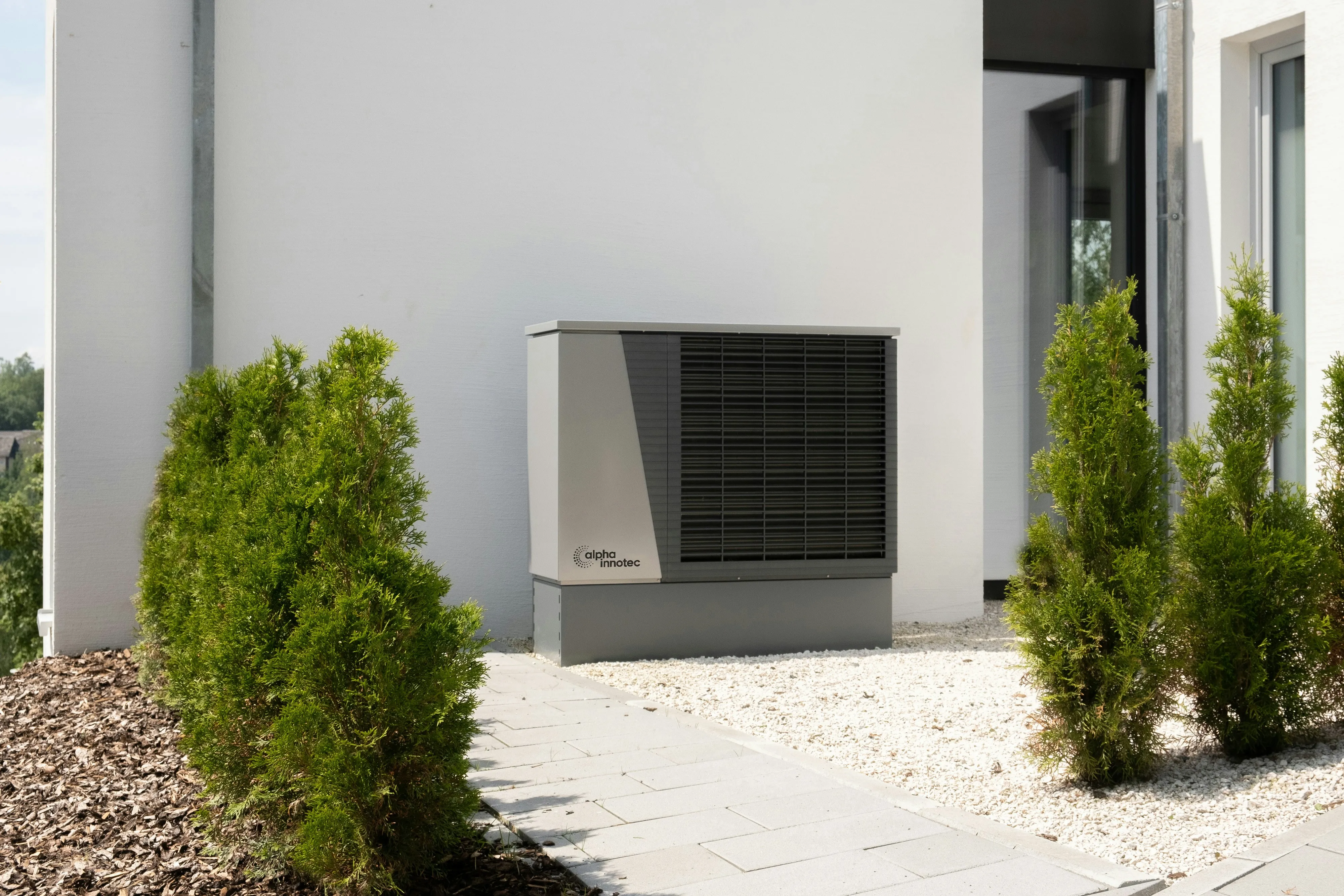
An air source heat pump (ASHP) is a heating system that moves heat from the outdoor air into your home's heating water, rather than burning fuel to generate heat. It uses a refrigerant cycle — the same physics as your kitchen fridge, running in reverse — to extract ambient heat from outside, concentrate it through compression, and deliver it into your radiators, underfloor pipes, and hot water cylinder. There is no combustion, no flue, no gas connection.
A typical UK installation delivers around 3 to 4 units of heat for every 1 unit of electricity used. This ratio is called the Coefficient of Performance (COP) or, averaged across a UK heating season, the Seasonal Coefficient of Performance (SCOP). The minimum SCOP for an installation to qualify for the £7,500 BUS grant is 2.8 (set by MCS); the UK fleet average is around 3.87 according to HeatpumpMonitor.org's 2026 monitored install data; premium installations regularly reach 4.5 or higher. The mechanism is well-understood and the equipment is mature.
Most Reading heat pump installations use an air-to-water monobloc configuration. The "monobloc" part means all the refrigerant-cycle components sit inside the outdoor unit, and what flows into your house is heated water through insulated pipework. This is simpler to install than the alternative (split-system) and requires no specialist refrigerant handling on site. The "air-to-water" part means the heat is delivered into your existing wet heating system (radiators, underfloor pipes) rather than into ducted air — which is what makes heat pumps a natural retrofit for UK homes with existing wet central heating.
Three indoor components typically accompany the outdoor unit: a hot water cylinder sized for your usage (heat pumps heat water more slowly than a combi gas boiler, so a cylinder is usually needed), the controller, and any required pipework or buffer-tank components. The indoor plant footprint is smaller than a typical gas boiler installation. Our complete guide to how a heat pump works walks through the refrigerant cycle and the components in detail.
How heat pump installation works in Reading — the 8-step process
The full process from "considering a heat pump" to "annual servicing on a commissioned system" follows eight steps. Each is detailed below; the survey and design work in steps 4–5 are where the heaviest decisions are made, and the install in step 6 is the most visible piece.
-
1. Decide if a heat pump is right for your home
Before booking a survey, it's worth confirming a heat pump is the right call. Three rough indicators help: your existing heating is fossil-fuel (gas, oil, LPG) or off-grid electric, you plan to stay in the home for at least five years to recoup the upfront investment, and you have outdoor space to site an external unit with the required clearances. None of these are deal-breakers individually — period properties, smaller gardens, and shorter-stay timelines all have workable answers — but together they tell you whether a heat pump is the obvious move or whether the survey will need to weigh trade-offs.
-
2. Check your eligibility for the £7,500 BUS grant
The Boiler Upgrade Scheme (BUS) is the UK government's heat pump grant for England and Wales. Eligible properties are owner-occupied or privately-rented (not new-build), and the heat pump must replace an existing fossil-fuel system or off-grid electric heating. The installer must be MCS-certified to claim. The grant is administered by Ofgem and is applied for by your installer on your behalf — you don't handle the paperwork. Full eligibility detail is on our [cost and BUS grant page](/cost-and-bus-grant/).
-
3. Find an MCS-certified installer
MCS certification is the UK quality-assurance standard for renewable heat installations. It's required to claim the £7,500 BUS grant, and most heat pump manufacturer warranties require MCS installation to remain valid. You can verify any installer on the live MCS register at mcscertified.com. Our Reading-area network is MCS-certified across the board — see the [methodology page](/methodology/) for the full vetting criteria we apply on top of MCS.
-
4. Choose your system — brand, type, sizing
System selection is driven by your survey. The choice usually comes down to brand (Daikin, Mitsubishi Electric, Vaillant, Worcester Bosch, Grant UK are the major UK options), refrigerant type (R32 for moderate flow temperatures, R290 for higher flow temperatures and longer-term regulatory alignment), and kilowatt sizing matched to your property's heat-loss calculation. The right answer is property-specific — a 7 kW Daikin Altherma 3 R suits a well-insulated 1980s semi; a 12 kW Vaillant aroTHERM plus R290 suits a less-insulated Victorian end-terrace. The survey produces the recommendation; your installer talks you through the trade-offs.
-
5. Prepare for installation — survey, electrics, planning
Before installation day, the installer carries out a pre-installation survey (heat-loss calculation, radiator sizing assessment, outdoor unit siting, electrical capacity check), confirms the BUS grant application, and identifies any preparatory work — radiator upgrades on rooms where existing emitters are undersized, an electrical supply upgrade if your consumer unit can't accept the heat pump's load, or planning permission paperwork if your property falls outside Permitted Development (most don't). This preparation phase typically takes 2–4 weeks between survey and installation start.
-
6. Install the heat pump system — 3–6 days on site
Installation itself takes 3–6 days on site for a typical Reading home. The outdoor unit is positioned and bolted to a wall mount or ground plinth; the indoor components (hot water cylinder if needed, the controls and pipework) go into a plant cupboard or utility room. Insulated flow-and-return pipework runs between the two. Existing radiators that need upgrading are swapped during the same visit. The installer pressure-tests the system, fills it, and commissions it before handover. The boiler is removed on the same job (or in a coordinated changeover if your existing heating is mid-season and you can't afford a heat-off period).
-
7. Commissioning and handover with documentation
Commissioning is where the heat pump's efficiency is set. Refrigerant charge, flow temperature, weather compensation curve, hot water schedule — each is configured for your specific property and use pattern. A well-commissioned system at handover is the difference between a SCOP of 3.0 and a SCOP of 4.0 across the same hardware. You receive an MCS certificate, the BUS grant paperwork, the manufacturer warranty registration, and a written commissioning record. The installer walks you through the controls and the expected behaviour through the first winter.
-
8. Annual servicing and ongoing maintenance
Heat pumps need less maintenance than a gas boiler but they are not maintenance-free. An annual service covers refrigerant pressure checks, filter cleaning, condensate drainage inspection, and a performance check against the commissioned baseline. Maintenance contracts (quarterly visits, priority response) are available for homeowners who want predictable upkeep. Our [servicing](/heat-pump-servicing/) and [maintenance](/heat-pump-maintenance/) pages cover what's included; the relevant takeaway is that an annual service typically costs £100–£200 and meaningfully protects both efficiency and warranty validity.
The £7,500 Boiler Upgrade Scheme (BUS) grant
The Boiler Upgrade Scheme is the UK government scheme that pays up to £7,500 toward an air source heat pump installation for eligible homeowners in England and Wales. The grant is administered by Ofgem and applied for by your MCS-certified installer on your behalf.
Eligibility
The grant covers properties that meet three core conditions:
- The property is in England or Wales, owner-occupied or privately rented (new-build properties are excluded).
- The heat pump replaces an existing fossil-fuel heating system (gas, oil, or LPG) or an off-grid electric heating system.
- The installation is carried out by an MCS-certified installer.
Specific edge cases (replacement heat pump installations, properties on heritage protection orders, hybrid systems) are detailed on our cost and BUS grant page and on the gov.uk Boiler Upgrade Scheme overview. The £9,000 off-gas oil/LPG uplift announced by DESNZ in April 2026 is expected to open in July 2026 and runs to 31 March 2027 — eligible off-grid properties will be able to claim this higher amount when the scheme opens.
How the application works
Your installer submits the BUS application on your behalf. The application is made before the installation begins and approval is typically received within 14 days (Ofgem's standard window). The grant amount is paid directly to the installer; your installation quote shows the price after the grant has been deducted, so the figure you sign for is the net amount you actually pay. No homeowner paperwork is required for the grant beyond signing the application form your installer prepares.
What's covered
The £7,500 grant is a fixed contribution toward the installation cost. It is not a percentage — every eligible installation receives £7,500, regardless of whether the total installation cost is £8,000 or £14,000. The grant covers the heat pump system itself, the labour, the materials needed for installation, and the commissioning. It does not cover ancillary work that's not strictly part of the heat pump installation (a new electrical consumer unit, extensive structural alterations, fabric-first insulation upgrades).
Full eligibility detail, the application timeline, and what to do if your property has unusual heating history are covered on our cost and BUS grant guide.
Cost of heat pump installation in Reading
Heat pump installation costs vary significantly with property type, system size, and the scope of related work (radiator upgrades, hot water cylinder, electrical capacity). Below are the ranges you'll typically see in the Reading market — each from a public source — and a "net cost after BUS grant" range that reflects what most eligible Reading homeowners actually pay.
Typical install cost (£8,000–£14,000)
According to the Energy Saving Trust (2026), a typical UK air source heat pump installation costs between £8,000 and £14,000 before any grants. Checkatrade's aggregate of UK install quotes shows a wider range (£1,000–£15,000) reflecting the variation between small replacement jobs and full new-system installations. Manufacturer-anchored quotes from companies like Stiebel Eltron tend to land in the £10,000–£14,000 range for full retrofit installations.
Your quote will vary based on heat-loss-calculated system size, brand and refrigerant choice, the number of radiators that need upgrading, and whether your existing electrical supply needs uprating. Request a free quote for a figure specific to your property.
Net cost after the BUS grant (£500–£6,500)
Subtracting the £7,500 BUS grant from the install-cost range above gives a net cost most eligible Reading homeowners pay between £500 and £6,500. Properties at the bottom of the range typically have minimal radiator upgrade work and an existing-but-suitable hot water cylinder. Properties at the upper end typically need full radiator upgrades, a new hot water cylinder, and electrical upgrades. The Reading distribution sits closer to the middle — £2,500–£4,500 net is the typical inter-war and modern-estate retrofit.
For more detailed cost breakdowns by category, see our cost and BUS grant guide — the dedicated cost page on this site.
Comparing to gas boiler installation
A like-for-like gas boiler replacement in a Reading home typically costs £2,500–£4,500 installed. After the BUS grant, the net cost of a heat pump installation in many Reading properties is comparable to or only modestly higher than a gas boiler replacement. The cost case for a heat pump strengthens further when running costs, lifespan (heat pumps last 15–20 years vs 10–15 for gas boilers), and the trajectory of gas-versus-electricity pricing are factored in. Request a quote for a property-specific comparison.
Comparing heat pumps to gas boilers — running costs
The running-cost comparison between a heat pump and a gas boiler depends on three variables: the heat pump's SCOP (efficiency), the price you pay per kWh of electricity vs the price per kWh of gas, and your annual heating energy use.
At a SCOP of 3.5 (mid-range for a well-designed retrofit) and current UK electricity prices, a heat pump's running cost per kWh of delivered heat is broadly comparable to a gas boiler's running cost — sometimes slightly higher on a standard electricity tariff, sometimes slightly lower depending on the household. The cost picture shifts materially on a heat-pump-specific electricity tariff (Octopus Cosy, EDF Heat Pump, OVO Heat Pump Plus): these tariffs offer reduced-rate windows during the periods heat pumps typically run, and a household with a smart-scheduled heat pump can land 20–40% below gas-boiler running costs on the right tariff.
SCOP determines how much electricity the heat pump uses per kWh of heat delivered. A SCOP of 4.0 uses 25% less electricity than a SCOP of 3.0 for the same heat output — a meaningful difference across a year. This is why heat-loss calculation, flow-temperature optimisation, and commissioning quality matter so much for the cost case: poorly-installed heat pumps run at SCOPs of 2.5–3.0 and cost more to run than the headline figures suggest. Well-installed heat pumps run at SCOPs of 3.5–4.5+ and deliver the running-cost picture the marketing claims.
The Energy Saving Trust publishes updated running-cost comparisons as electricity and gas wholesale prices shift; see their running cost calculator for the current figures. Our running costs guide walks through how to estimate your specific household.
Payback period — the time it takes the lower running cost to repay the higher upfront cost — typically lands at 7–15 years for a well-designed Reading retrofit, depending on tariff choice, household heating use, and whether like-for-like gas replacement is the relevant counterfactual or a more efficient new gas boiler. The payback case is strongest for off-gas-grid households (where the heat pump replaces oil or LPG, both significantly more expensive per kWh than gas), and weakest for households already on the most efficient gas tariffs.
Heat pump types and brands
UK heat pump installations fall into three main types, and a small number of manufacturers dominate the Reading market. The right choice depends on your property and budget.
Heat pump types compared
| Type | Typical cost | UK retrofit fit | BUS eligible | Hot water |
|---|---|---|---|---|
| Air-to-water (most common) | £8,000–£14,000 | Excellent — uses existing radiators and pipework | Yes (£7,500) | Yes (via cylinder) |
| Air-to-air | £5,000–£10,000 | Limited — requires ducted air; common in flats with no wet system | No | No (heating only) |
| Ground source | £20,000–£30,000+ | Limited — needs garden space for boreholes or trenches | Yes (£7,500) | Yes (via cylinder) |
For the vast majority of Reading retrofits, air-to-water is the right call. It works with your existing radiator system, qualifies for the BUS grant, and provides both heating and hot water. Air-to-air suits flats or properties without wet central heating; ground source suits larger gardens, new builds, or properties already considering significant ground works.
Major UK heat pump brands
-
Daikin
Wide UK installer base, strong supply chain. Daikin Altherma 3 R (R32) and Altherma 3 H HT (R32) are the high-volume retrofit picks. Daikin's R290 monobloc range is in market across Europe.
-
Mitsubishi Electric
Ecodan range is well-established in UK retrofits. Strong post-install support and an installer network of long-trained partners. R32 Ecodan is the standard product; R290 in development.
-
Vaillant
aroTHERM plus (R290) is one of the strongest current retrofits — high flow temperature (up to 75°C), making it suitable for period properties without radiator overhaul. German engineering pedigree.
-
Worcester Bosch
Familiar brand for UK homeowners who previously had a Worcester gas boiler. Greenstar heat pump range; competitive on price; strong national installer network. R32 across current lineup.
-
Grant UK
Aerona³ heat pump range. UK-headquartered manufacturer with strong support for rural and off-grid installations — often the right call for properties replacing oil-fired heating.
-
Samsung
EHS Mono (R32) and EHS Mono R290 are competitive on price. Less common in UK retrofits than the brands above; some installers carry Samsung as a value option.
The brand decision is made during your survey, based on the property's heat-loss profile, the flow temperature your radiator system can run at, your budget, and any specific preferences you have. Most Reading installers in our network are authorised on two to four brands; we route your enquiry to an installer whose brand portfolio fits your survey requirements.
Reading installer credentials we require
Our installer network is built around a clear set of credential requirements. Two are mandatory — installers who lack either are not in our routing pool. Three are preferred — they raise an installer's standing but are not pass/fail.
- MCS certification (mandatory). The Microgeneration Certification Scheme is the UK quality-assurance standard for renewable heat installations. Required for the £7,500 BUS grant and for most manufacturer warranties. We verify each installer against the live MCS register.
- Reading-area presence (mandatory). The installer must actively cover Reading and the surrounding RG postcodes — not just list Reading as a "covered area" while routing through a distant office.
- TrustMark (preferred). The government-backed quality scheme that sits alongside MCS for retrofit work. We verify via the TrustMark directory.
- Manufacturer authorisations (preferred). Direct authorisation from Daikin, Mitsubishi Electric, Vaillant, Worcester Bosch, or Grant UK. Indicates brand-specific commissioning training and access to extended warranty terms.
- Heat Geek tier (preferred where available). Heat Geek's independent heat-pump training programme. Tiers (Bronze, Silver, Gold, Elite) indicate depth on heat pump design specifically.
The full criteria, the verification process, and how we keep the pool current are on our methodology page.
Reading neighbourhoods we cover
Our installer network covers all major Reading neighbourhoods and the surrounding area. Different neighbourhoods come with different installation considerations — Victorian terraces have specific space and ventilation constraints, post-war estates often allow easier outdoor unit placement, and newer-build estates may already have the electrical capacity for a heat pump.
- Heat pumps in Caversham →
- Heat pumps in Earley →
- Heat pumps in Lower Earley →
- Heat pumps in Tilehurst →
- Heat pumps in Whitley →
- Heat pumps in Woodley →
- Heat pumps in Reading town centre →
- Heat pumps in Thatcham →
View the full Areas page → — surrounding villages and parts of West Berkshire are also covered on a case-by-case basis depending on the installer's route.
Ground source vs air source — when each makes sense
Both air source and ground source heat pumps qualify for the £7,500 BUS grant. The choice between them comes down to property suitability, garden space, and budget.
| Air source heat pump | Ground source heat pump | |
|---|---|---|
| Upfront cost | £8,000–£14,000 | £20,000–£30,000+ |
| Install disruption | 3–6 days on site | 2–4 weeks (incl. ground works) |
| Garden requirement | ~1 m² for outdoor unit | Borehole or trench area |
| Typical SCOP | 3.5–4.5 | 4.0–5.0 |
| Lifespan | 15–20 years | 20–25 years (heat pump); 50+ years (ground loop) |
| BUS grant | £7,500 | £7,500 |
For most Reading retrofits — terraced and semi-detached properties on standard plot sizes — air source is the right call. The upfront cost difference is rarely repaid by the modest efficiency gain of ground source within the equipment's lifespan, and the install disruption (ground works in a typical Reading garden) is substantial. Ground source suits properties with significant garden space, new builds where the ground works can be coordinated with the build, and off-gas-grid rural properties where the upfront cost is offset by the highest available SCOP and decades of reduced running costs.
If you're weighing the two for your specific property, request a quote and the survey will identify which (if either) fits the site.
Frequently asked questions
What is the 30 minute heating rule?
The "30 minute rule" refers to a heat pump's ability to bring a room up to set temperature within roughly 30 minutes of demand, when properly sized. In practice, well-designed heat pumps don't work like that — they run continuously at a low flow temperature rather than cycling on hard for short bursts the way an oversized gas boiler does. A heat pump that needs 30-minute bursts to hit set temperature is typically undersized or running at too low a flow temperature for the property. The metric to ask about isn't 30-minute warm-up time, it's whether the system maintains set point efficiently across a 24-hour cycle.
How do you calculate heat pump requirements?
Heat pump sizing starts from a room-by-room heat-loss calculation. The installer measures or estimates each room's exposed wall area, window area, glazing performance, floor type, ceiling type, and air change rate; combines those with the property's design indoor temperature (typically 21°C in living areas, 18°C in bedrooms) and Reading's design outdoor temperature (around -3.4°C per CIBSE data); and produces a kW heat-loss figure per room. The heat pump is sized to match the building's total heat loss at design conditions, plus a small safety margin. Rule-of-thumb sizing (matching the kW of the old gas boiler) typically oversizes the system because gas boilers are themselves oversized — proper heat-loss calculation usually lands at 60–75% of the old boiler's nameplate kW.
What number should my heat pump be on?
Most heat pump controllers don't display a single "setting" the way a gas boiler thermostat does — they show flow temperature, target room temperature, and a weather compensation curve. The flow temperature setting depends on your property: 35°C for underfloor heating, 45–50°C for well-sized radiators in an insulated home, 55°C for retrofitted standard radiators. The target room temperature is your call (21°C in living spaces is typical). The weather compensation curve adjusts flow temperature based on outdoor conditions automatically — once it's set during commissioning, you generally don't touch it. If you're being asked to tweak the heat pump's settings regularly, the commissioning probably needs revisiting.
How should a heat pump be installed?
Correctly-installed heat pumps share a handful of features: a heat-loss calculation drives the kW sizing rather than rule-of-thumb; the flow temperature is set as low as the property will allow (lower flow = higher efficiency); radiators are checked for output at the design flow temperature and upgraded where they're undersized; the outdoor unit is sited with the required clearances from windows, doors, drains, and boundaries (and complying with permitted-development noise limits where applicable); weather compensation is configured during commissioning; a hot water cylinder is sized to the property's hot water usage pattern. Each of these steps is part of the MCS standard. An installer who skips heat-loss calculation or radiator sizing is cutting corners that will show up as poor SCOP and high running costs.
How long does heat pump installation take in Reading?
Most Reading heat pump installations take 3–6 days on site, plus 2–4 weeks of preparation between survey and installation start. The on-site work is faster if no radiator upgrades are needed; slower if a hot water cylinder is being added or the electrical supply needs upgrading. The pre-installation survey gives you a specific timeline once your property has been assessed.
Do I need planning permission for a heat pump in Reading?
Most Reading heat pump installations fall under Permitted Development, which means no planning application is needed. PD requires that the outdoor unit volume is below the relevant threshold (1.5 m³ from December 2023 regulations), that noise output meets the MCS 020 noise standard at the nearest residential window, and that siting clearances are observed. Conservation areas and listed buildings have additional restrictions — Caversham conservation areas and any listed property in central Reading need a planning consent check before installation. Your installer handles the PD compliance check or planning application as part of the pre-installation work.
Will I need new radiators with a heat pump?
Some radiators may need upgrading. Heat pumps run at lower flow temperatures than gas boilers, so existing radiators are sometimes undersized for the new system — particularly in older properties with original radiators. A heat-loss-and-emitter assessment during the survey identifies which radiators (if any) need replacing. Most Reading homes need radiator upgrades on a subset of rooms (typically bedrooms or rooms with the largest exposed wall area) rather than the whole house. The cost of any required radiator upgrades is included in the installation quote.
Are heat pumps suitable for Victorian houses in Reading?
Yes — most Victorian houses in Reading, including the terraces common in Caversham and central Reading, are heat-pump-suitable with the right system specification. The combination of an R290 heat pump (capable of higher flow temperatures up to 75°C) and any necessary radiator upgrades makes Victorian retrofits straightforward. Insulation upgrades — cavity wall insulation isn't an option in solid-wall properties, but loft insulation, internal wall insulation, and draught-proofing all help. The age of the building rarely prevents a heat pump from working; it changes which heat pump and which radiator strategy makes sense.
Do heat pumps work in cold weather?
Yes — comfortably. Modern air source heat pumps in the UK operate down to outdoor temperatures of -10°C to -25°C depending on model. Reading's coldest typical winter design temperature is around -3.4°C. Heat pumps lose efficiency in cold weather (the wider the gap between outdoor and flow temperature, the lower the COP), but they keep working — and most UK heating hours happen at mild outdoor temperatures, not extreme cold. Our [guide on heat pumps in cold weather](/guides/do-heat-pumps-work-in-cold-weather/) covers the real-world evidence from Scandinavia and the UK.
What is SCOP and why does it matter?
SCOP — Seasonal Coefficient of Performance — measures how much heat a heat pump produces per unit of electricity, averaged across a UK heating season. A SCOP of 3.5 means 3.5 kWh of heat delivered for every 1 kWh of electricity consumed. The minimum SCOP to qualify for the BUS grant is 2.8 (set by MCS); the UK fleet average is around 3.87 (per HeatpumpMonitor.org's 2026 monitored installation data); premium retrofits hit 4.5+. SCOP is the number to ask about when comparing systems — it determines your running cost more than any other variable.
How much does heat pump installation cost in Reading?
Reading heat pump installations typically cost £8,000–£14,000 before the £7,500 BUS grant — so £500–£6,500 net. The cost depends on your property type, system size, brand, and whether radiator upgrades or a hot water cylinder are needed. Specific cost ranges, with source attribution, are on our [cost and BUS grant page](/cost-and-bus-grant/). For an accurate figure for your specific home, [request a free quote](#quote-form).
What's the difference between a monobloc and a split-system heat pump?
Monobloc heat pumps house all four refrigerant-cycle components (evaporator, compressor, condenser, expansion valve) inside the outdoor unit. What flows into your house is heated water through insulated pipework. Split-system heat pumps have the compressor outdoors but the condenser indoors, with refrigerant running between them in copper pipework. Most UK retrofits are monobloc because they're simpler to install and require no specialist refrigerant handling on site. Our [guide on monobloc vs split-system](/guides/monobloc-vs-split-heat-pump/) covers the trade-offs in more depth.
Will a heat pump work with my existing radiators?
In many cases yes — but some radiators may need upgrading. Heat pumps work best at lower flow temperatures (35–55°C) than gas boilers (typically 70°C). Radiators sized for a gas boiler may not deliver enough heat at the lower flow temperature without being upgraded to larger panels or to type 22 or type 33 designs. The pre-installation survey assesses each radiator and identifies what (if anything) needs replacing.
Does a heat pump need an indoor unit?
An air source heat pump installation typically includes a small set of indoor components: a hot water cylinder (if you don't have one already or yours is unsuitable for heat pump duty), the controller, and the pipework connections. The compressor and refrigerant cycle live in the outdoor unit. The indoor footprint is much smaller than a gas boiler's plant cupboard — for some installs, the only new indoor item is the hot water cylinder.
Get a quote — Reading heat pump installation
Submit the form on the homepage and we'll respond within 24 hours. We'll route your enquiry to a Reading-area MCS-certified installer in our network whose brand portfolio and capacity fit your property. The survey is free, and the quote that follows shows you the actual figure you'll pay — net of the £7,500 BUS grant, with any required radiator upgrades or cylinder costs included so there are no surprises later.