Do heat pumps work in Victorian houses? An old-property retrofit guide
Last reviewed: 14 May 2026
Yes — Victorian and Edwardian properties can be heated by air source heat pumps, and a growing UK fleet of installs proves it. What changes for old-property retrofit is the design discipline: four specific decisions need to navigate solid-wall heat loss, radiator output at lower flow temperatures, microbore pipework, and (for conservation areas and listed buildings) planning constraints.
Last reviewed: 14 May 2026
In short
Heat pumps work in Victorian and Edwardian properties — the technical question is settled. What changes for old-property retrofit are four design decisions the installer has to navigate: higher calculated heat loss (driven by solid brick walls without cavity insulation), older radiators that need upsizing for 45–55°C flow temperature, microbore pipework that may not carry the heat pump’s flow rate, and planning constraints in conservation areas and listed buildings. The Boiler Upgrade Scheme grant of £7,500 has been accessible to period properties since April 2026 — the EPC requirement that previously gated older properties was struck entirely by SI 2026/390. Real-world cost outcomes for a 3-bed Victorian terrace with moderate fabric upgrades typically run £14,000–£20,000 gross (£6,500–£12,500 net of BUS).
Contents
- What Victorian/Edwardian actually means for retrofit
- The four design challenges and how to navigate them
- What a typical Victorian install costs
- Real-world SCOP performance
- Five questions to ask before committing
- What this means for your decision
- What this means for homes in Reading
What Victorian/Edwardian actually means for retrofit
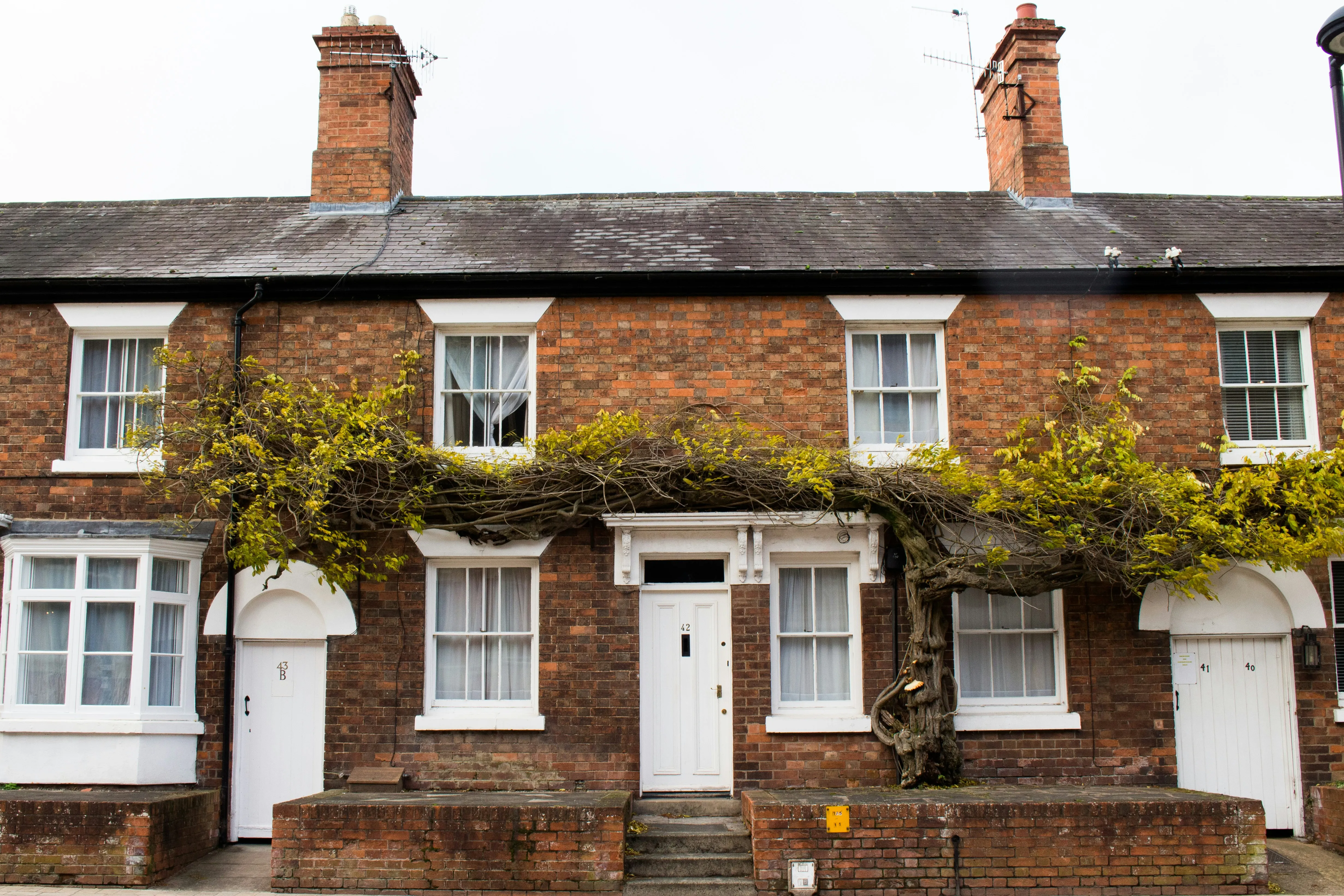
Victorian properties were built between roughly 1837 and 1901; Edwardian between 1901 and 1914. From a heating retrofit perspective, both share the structural characteristics that distinguish them from later UK housing stock:
- Solid brick wall construction, typically 9” (225 mm) brick walls without cavity. Cavity construction with insulation was not the norm until the 1930s.
- Suspended timber ground floors over a ventilated underfloor void.
- Sash or original casement windows, typically single-glazed in their original specification (most have since been replaced or upgraded, but not all).
- Higher ceilings than modern construction (typically 2.6–3.2 m vs the 2.4 m modern standard) — increases room volume, increases heating demand, increases ventilation losses.
- Period features worth preserving — cornicing, picture rails, original fireplaces, decorative ironwork — which constrain retrofit options (internal wall insulation can damage cornicing; external wall insulation changes street-facing appearance).
- Original radiators and pipework designed for the high-flow-temperature gas-boiler era, or in some cases the original cast-iron radiators from late-Victorian / Edwardian central heating systems.
These characteristics produce a typical Victorian / Edwardian property heat-loss profile around 2× higher than a comparable-floor-area modern estate property. A 3-bed Victorian terrace in central Reading might calculate to 9–12 kW design-day heat loss; an equivalent floor-area modern semi in Lower Earley calculates to 4–6 kW.
The four design challenges and how to navigate them
1. Higher calculated heat loss
The defining characteristic of solid-wall construction: external wall heat transmission is roughly 2.5–3× higher per square metre than a cavity-filled wall. For a typical 3-bed terrace with ~50 m² of external wall area, the wall heat loss alone might be 3.5–5 kW vs 1.5–2 kW for an equivalent cavity-walled property.
Retrofit options:
-
Accept the higher heat loss and size the heat pump accordingly. A 12 kW air-to-water heat pump sized to the calculated load works correctly — it just costs more upfront than the 8 kW unit a modern semi might need (~£1,500–£2,500 more), and runs at a slightly lower SCOP because the design flow temperature is typically higher.
-
Add internal wall insulation (IWI) before specifying the heat pump. Cost £4,000–£12,000 for a 3-bed terrace. Reduces wall heat loss by 50–70%. Calculated load typically drops 30–40% after IWI, often allowing the heat pump to size down one band.
-
Add external wall insulation (EWI) where conservation/aesthetic constraints permit. Cost £8,000–£18,000. Reduces wall heat loss by 60–75%. Subject to planning consent in many areas, and visible change to street-facing elevations.
The economic case for IWI or EWI before a heat pump install on a Victorian property is often stronger than the case for the same upgrade before a gas boiler — the heat pump’s lower flow temperature multiplies the fabric-quality SCOP benefit. (Our fabric-first guide covers the economics in depth.)
2. Radiator output at low flow temperature
Radiators sized in the gas-boiler era were calculated to deliver heat at 70–82°C flow temperatures. At a heat pump’s design flow temperature of 45–55°C, radiator output drops to ~50–65% of the rated output. A Victorian property’s existing radiators were almost certainly sized for high-temperature operation; for the heat pump’s lower temperature, larger radiators (or different formats — double-panel-double-convector “K2” / “type 22”; sometimes “K3” / “type 33” triple-panel) are typically required.
Typical retrofit scope: 4–8 radiators usually need upgrading from single-panel to double or triple-panel formats. Cost per radiator £150–£400 supply-and-fit; total radiator upgrade cost £1,500–£3,000.
The high-temperature heat pump alternative. Some current product lines (Daikin Altherma 3 H HT, Mitsubishi Ecodan PUZ-HWM, Vaillant aroTHERM plus VWL high-flow) are rated for 65–70°C flow temperatures, letting the installer skip the radiator upgrade — the existing radiators can be kept, since they were originally sized for similar flow temperatures.
The trade-off: a high-temperature heat pump runs at meaningfully lower SCOP. At a 65°C flow temperature, SCOP across the heating year typically lands at 2.8–3.2 vs 3.5–4.0 for a low-flow-temperature install with upgraded radiators. The 15-year running-cost penalty of a high-temperature install (vs the equivalent low-flow-temperature install) is typically £1,500–£3,500 higher.
The decision: the radiator upgrade investment of £1,500–£3,000 typically pays back within the asset life when measured against the SCOP gain. For most Victorian retrofit, the radiator-upgrade route gives better lifetime economics. (Our radiator-sizing guide covers this decision in depth.)
3. Pipework — particularly microbore
Some Victorian and Edwardian properties had wet central heating retrofitted in the 1970s–1990s using microbore copper pipework (typically 8 mm or 10 mm external diameter, sometimes 6 mm). Microbore has a smaller cross-sectional area than the standard 15 mm or 22 mm pipework used since the 2000s — which limits the flow rate the system can carry.
Heat pumps require higher flow rates than gas boilers — typically 0.6–1.2 m³/hr depending on unit size, vs a gas boiler’s 0.4–0.6 m³/hr. Microbore that worked for a gas boiler may not support a heat pump’s flow rate without excessive pressure drop.
Retrofit options:
- Replace the microbore pipework with 15 mm or 22 mm. Significant disruption — floors lifted, runs traced, joints made. Cost typically £1,500–£4,000 for a 3-bed Victorian terrace.
- Add a hydraulic separator (low-loss header) and primary/secondary circuit. The heat pump runs its own primary circuit at the required flow rate; the existing microbore handles the secondary at its native rate. Cost £400–£1,500; SCOP penalty of 0.1–0.3 from the additional heat-transfer interface.
- Replace only the longest runs where microbore is the bottleneck. Cost £600–£1,500.
The MCS-compliant survey should identify pipework limitations at design stage. A heat pump install that doesn’t check pipework adequacy can produce post-install flow-rate problems showing up as poor SCOP or noisy circulation.
4. Conservation areas and listed buildings
Many Victorian and Edwardian terraces are within designated conservation areas. Some — particularly in central London, Bath, and Caversham Heights / Caversham Park in Reading — are listed buildings.
The planning rules:
- Permitted Development (PD) rights allow many heat pump installs without specific planning permission, subject to noise and siting conditions per MCS 020 and the Permitted Development Order. The 2023 expansion removed the 1 m³ volume limit and the 1 m boundary distance requirement, but kept the noise limit and a requirement that the unit be sited “in a location where it will be unobtrusive.”
- Conservation areas typically restrict PD rights on the front elevation. A heat pump on the rear elevation or in the back garden is usually within PD; one visible from the street typically requires planning consent.
- Listed buildings require Listed Building Consent for any external alteration, regardless of PD. The heat pump itself, the outdoor unit’s siting, any external pipework, and any changes to the external envelope require consent.
- External wall insulation is essentially never permissible on listed buildings and is constrained on conservation-area front elevations.
The practical outcome: the heat pump itself is usually installable in conservation areas and listed buildings, but the siting may be constrained, and external fabric upgrades may be off the table. Internal wall insulation, glazing upgrades, draught-proofing, and floor insulation are typically available even in listed buildings (subject to specific consent requirements).
For Reading specifically, the Reading Borough Council planning portal carries the definitive list of conservation areas and listed buildings.
What a typical Victorian install costs
A representative 3-bed Victorian terrace in Reading with moderate fabric upgrades:
| Component | Cost range | Notes |
|---|---|---|
| Air-to-water heat pump (10–12 kW) | £6,500–£9,500 | Larger unit for higher calculated load |
| Hot water cylinder (250 L unvented) | £800–£1,500 | Larger cylinder for 3-bed occupancy |
| Radiator upgrades (5–8 units) | £1,500–£3,000 | Double or triple panel replacements |
| Pipework adjustments | £600–£2,500 | Depends on microbore presence + replacement scope |
| Electrical work (consumer unit + DNO notification) | £400–£800 | DNO upgrade rare in Reading area |
| Survey, design, project management | £600–£1,500 | Usually included in installer’s quote |
| Subtotal: heat pump + system | £10,400–£18,800 | |
| Loft insulation top-up | £400–£1,200 | Most properties benefit |
| Cavity wall insulation | n/a | No cavity on Victorian solid-wall stock |
| Internal wall insulation (1–2 main rooms) | £2,000–£6,000 | Partial; full property £4,000–£12,000 |
| Draught-proofing | £200–£800 | |
| Glazing (if not already replaced) | £4,000–£8,000 | If single-glazed at start |
| Subtotal: fabric upgrades | £600–£16,000 | Range depends on scope |
| Gross total (heat pump + reasonable fabric) | £11,000–£34,800 | |
| BUS grant offset | −£7,500 | Air-to-water grant |
| ECO4 / Warm Homes Local Grant (eligible) | −£0 to −£6,000 | Means-tested |
| Net cost to homeowner | £3,500–£27,300 | Depends heavily on fabric scope and grant eligibility |
The table’s point: Victorian retrofit cost varies hugely depending on (a) the fabric upgrade scope the homeowner commits to and (b) grant eligibility. A homeowner who does the basics (loft top-up + radiator upgrades) lands at the lower end; a homeowner who completes full internal wall insulation, draught-proofing, and glazing lands at the upper end. Both are valid choices; lifetime economics favour the more complete fabric upgrade, but the upfront commitment varies substantially.
Real-world SCOP performance
Field-trial data on Victorian-property heat pump performance:
- Properties with minimal fabric upgrades (radiator upgrades only, no IWI): SCOP typically 2.8–3.2 across the heating year. Design flow temperature 55–60°C; higher running cost vs better-fabric installs.
- Properties with moderate fabric upgrades (loft + draught-proofing + glazing): SCOP typically 3.0–3.5. Design flow temperature 50–55°C.
- Properties with full fabric upgrades (loft + draught-proofing + glazing + IWI): SCOP typically 3.5–4.0. Design flow temperature 45–50°C; performance approaches that of modern-build heat pump installs.
The pattern: fabric-first investment compounds with the heat pump performance. The Victorian property that runs at SCOP 3.5+ is the same property that running-cost-wise behaves like a modern semi with a heat pump — the technology is identical; the upfront fabric investment is what closes the performance gap.
Five questions to ask before committing
For a Victorian-property heat pump quote, five specific verification questions:
1. Has the calculated heat loss been done to BS EN 12831-1:2017 with the property’s solid-wall construction correctly identified? Pre-2017 calculation tools sometimes treated solid walls similarly to cavity walls, over- or under-stating losses. Current tools (MCS Heat Load Calculator, Heat Engineer, HeatPunk) have specific solid-wall U-value defaults; the survey should reference these.
2. What design flow temperature has been specified, and what’s the expected SCOP? A 55°C+ flow temperature with no fabric-first upgrades typically delivers SCOP 2.8–3.2; a 45–50°C flow temperature with moderate fabric upgrades delivers SCOP 3.5–4.0. The installer should be able to give both figures and explain the trade-off.
3. Have the existing radiators been audited room-by-room against the design flow temperature? Each radiator should have a calculated required output at the design flow temperature, and a clear flag for “keep / upgrade / replace.” A survey that says “radiators look OK” without per-room data is incomplete.
4. Has the pipework been checked for microbore? If microbore is present, what’s the remediation plan — full replacement, hydraulic separator, or partial replacement? Each has cost and SCOP implications.
5. What conservation-area or listed-building constraints apply, and have they been factored into siting and external fabric work? For Reading homeowners: Caversham Heights, Caversham Park, central Reading conservation areas, and St Mary’s listed-building concentrations should be checked against the Reading Borough Council planning portal at quote stage.
Where the installer can answer all five clearly, the design is on documented evidence. Where one or more answers are vague, that’s where the post-install variance typically appears.
What this means for your decision
The decision-relevant answer for a Victorian-property homeowner considering a heat pump in 2026:
- Yes, a heat pump will heat your Victorian property to setpoint year-round — the design is established and the technology is proven across a growing UK fleet of period-property installs.
- Expect a higher upfront cost than a modern-stock install — typically £11,000–£20,000 gross for the heat pump + system + reasonable fabric, vs £8,000–£14,000 for a modern semi.
- Expect a higher running cost than a modern-stock install — typically 15–30% higher, driven by higher residual heat loss after fabric upgrades.
- Plan fabric upgrades as part of the lifetime investment — the £4,000–£12,000 internal wall insulation cost typically pays back through SCOP gain + running-cost saving + reduced heat pump capital across the 15-year asset life.
- Check conservation-area and listed-building rules early — if you’re in Caversham Heights, Caversham Park, central Reading conservation areas, or any listed building, get the planning constraints clear before the design phase invests effort in options that may be off the table.
- BUS grant access is the same as for modern properties since April 2026 — the EPC requirement that previously created an additional hurdle for older properties was struck entirely by SI 2026/390.
Victorian and Edwardian properties are some of the more rewarding heat pump retrofits in the long run. The fabric improvements you make for the heat pump also reduce summer overheating, improve comfort year-round, and increase the property’s long-term value as the UK heat transition continues. The upfront investment is higher, but the lifetime envelope is workable.
What this means for homes in Reading
Reading has substantial Victorian and Edwardian terrace stock, concentrated in three areas:
Central Reading — the town-centre Victorian terraces between the station and the river, plus the late-Victorian terraces extending into the eastern town and along the Oxford Road corridor. Most of this stock is solid-walled, with mixed glazing (some original sash; some 1990s–2000s double glazing replacements; some recent A++ replacements). Many properties have had loft insulation topped up since 2010 but few have internal wall insulation. Heat pump sizing typically 10–14 kW.
Lower Caversham — the substantial Edwardian terrace stock north of the river. Similar fabric to central Reading Victorian stock, with some additional period detail worth preserving. Heat pump sizing typically 9–13 kW.
Caversham Heights and Caversham Park — late-Victorian and Edwardian villas, many in conservation areas with selective listed-building status. The largest properties (often 4–5 bed) push into 14–16 kW territory; full fabric upgrades face conservation-area constraints on external work but internal upgrades remain accessible.
The Reading-specific design notes:
- The design external temperature is −3°C (CIBSE Guide A, Heathrow reference), same as everywhere in the Thames Valley. Reading’s climate isn’t a Victorian-property-specific challenge.
- Reading is on the gas grid, which means most Victorian terraces are replacing gas boilers (not oil) and qualify for the £7,500 BUS grant without the £9,000 off-gas uplift announced for July 2026.
- Conservation area scope in Reading is concentrated in St Mary’s, central Reading core, Castle Hill, Caversham Heights, and Caversham Park. The Reading Borough Council planning portal carries the definitive list — check before committing to a design.
- Reading’s planning committee has generally been receptive to heat pump applications in conservation areas where the unit is appropriately sited (rear gardens, side returns); Listed Building Consent applications for heat pumps in listed properties have a mixed track record, with sympathetic siting typically the deciding factor.
For Reading homeowners with Victorian or Edwardian properties, the heat pump conversation is a longer-horizon decision than for modern-estate stock — higher upfront cost, larger fabric scope, often staged across 2–5 years rather than completed in a single retrofit. But the technology fits, the grant pathway is open, and the long-term economic and comfort outcome is favourable. The MCS-certified installer’s survey-and-design phase is the place to map your specific property’s path.
Related guides
- Do you need bigger radiators for a heat pump? — the radiator-upgrade decision in depth
- High-temperature heat pumps for old-radiator retrofits — the alternative-to-radiator-upgrade path (A3.5 — publishes cadence)
- Fabric-first principle — the IWI / draught-proofing / glazing decisions in depth
- Heat loss surveys for heat pumps — the survey methodology including period properties
Get a quote for a heat pump install in your Reading Victorian or Edwardian property. Our survey covers solid-wall heat loss, radiator audit, pipework check, and conservation-area / listed-building planning constraints. | Call us on 0118 [number] | Email [address]
See what a heat pump would look like in your Reading home
The mechanism is the same in every UK home; the design is specific to yours. Our team carries out a free in-home survey including a full room-by-room heat-loss calculation, identifies the system size and configuration that fits your property, and provides a written quote with the £7,500 BUS grant already deducted.
You'll see the actual figure you'd pay — not an estimate — and the projected efficiency for your specific install.